
In the vast ecosystem of Java Programming, few features have had as profound an impact on code quality, readability, and safety as Generics. Introduced in Java 5, Generics fundamentally changed how developers interact with the Java Collections Framework and define reusable object-oriented structures. For anyone embarking on a journey through Java Development, understanding Generics is not merely an optional skill—it is a cornerstone of writing clean, disciplined, and scalable applications.
Before Generics, Java code was often cluttered with explicit type casting and prone to runtime ClassCastException errors. As the language has evolved through Java 17 and Java 21, the type system has become more robust, allowing for sophisticated design patterns that underpin modern frameworks like Java Spring and Hibernate. Generics provide the mechanism to enforce type safety at compile-time rather than runtime, allowing developers to catch errors early in the development cycle.
This article serves as a comprehensive technical guide to Java Generics. We will move beyond the basics, exploring how to implement generic classes, methods, and interfaces, and diving into advanced topics like wildcards and type erasure. Whether you are building Java Microservices, a robust Java Backend, or optimizing Java Performance, mastering these concepts is essential for professional software engineering.
The Core Concepts: Why Generics Matter
At its heart, the concept of Generics is about abstraction. It allows you to define classes, interfaces, and methods with placeholders for types, known as type parameters. This enables you to write code that can handle various data types while maintaining strict type safety. This aligns perfectly with Java Best Practices and the principles of Clean Code Java.
Type Safety and the Diamond Operator
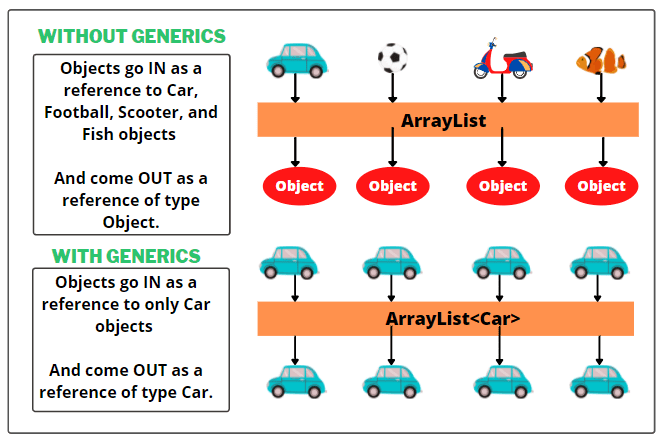
Without generics, collections operate on the Object type. This requires manual casting when retrieving items, which is a fragile process. Generics eliminate this need. When you define a List<String>, the compiler guarantees that only strings can be inserted into that list. If you attempt to insert an Integer, the code will fail to compile, preventing a potential crash in production.
Let’s look at a practical comparison between a non-generic approach and a generic approach. This demonstrates the discipline Generics bring to Java Architecture.
public class BoxComparison {

    // 1. Non-Generic Box (The Old Way)
    // Operates on Object, requiring casting and risking runtime errors.
    static class ObjectBox {
        private Object content;

        public void set(Object content) {
            this.content = content;
        }

        public Object get() {
            return content;
        }
    }

    // 2. Generic Box (The Modern Way)
    // Uses a Type Parameter <T> to enforce type safety.
    static class GenericBox<T> {
        private T content;

        public void set(T content) {
            this.content = content;
        }

        public T get() {
            return content;
        }
    }

    public static void main(String[] args) {
        // Scenario A: Unsafe casting
        ObjectBox rawBox = new ObjectBox();
        rawBox.set("Hello World");
        // Dangerous: The compiler allows this, but it might fail at runtime if logic is complex
        String str = (String) rawBox.get();

        // Scenario B: Type-Safe Generic
        // usage of the Diamond Operator <> inferred in Java 7+
        GenericBox<String> stringBox = new GenericBox<>();
        stringBox.set("Java Development");

        // No casting needed. The compiler knows this returns a String.
        String safeStr = stringBox.get();

        // Compile-time Error: stringBox.set(100);
        // This line would be flagged by the IDE immediately.

        System.out.println("Retrieved: " + safeStr);
    }
}
In the example above, T represents the type parameter. By convention, single uppercase letters are used (e.g., E for Element, K for Key, V for Value, T for Type). This standardization is crucial when working in teams or contributing to open-source Java Frameworks.
Implementation Details: Classes, Methods, and Interfaces
To truly leverage Generics for Java Scalability, one must understand how to apply them across different structural elements of the language. This is particularly relevant when designing libraries or the data layer of a Java Enterprise application.
Generic Interfaces and Classes
In modern Java Web Development, specifically when using Spring Boot and JPA (Java Persistence API), generics are heavily used to create reusable repositories. Instead of writing a separate data access object (DAO) for every entity, you can define a generic interface.
Consider a scenario where we are building a Java REST API. We need a standard way to perform CRUD (Create, Read, Update, Delete) operations on different data models.
import java.util.ArrayList;
import java.util.List;
import java.util.Optional;
import java.util.UUID;

// A Generic Interface for Data Access
// T: The Entity Type
// ID: The Primary Key Type
interface Repository<T, ID> {
    void save(T entity);
    Optional<T> findById(ID id);
    List<T> findAll();
}

// A simple domain entity
class User {
    private String id;
    private String username;

    public User(String username) {
        this.id = UUID.randomUUID().toString();
        this.username = username;
    }

    public String getId() { return id; }
    public String getUsername() { return username; }

    @Override
    public String toString() { return "User{name='" + username + "'}"; }
}

// Implementation of the Generic Interface
class InMemoryUserRepository implements Repository<User, String> {
    private List<User> database = new ArrayList<>();

    @Override
    public void save(User entity) {
        database.add(entity);
        System.out.println("Saved: " + entity);
    }

    @Override
    public Optional<User> findById(String id) {
        return database.stream()
                .filter(u -> u.getId().equals(id))
                .findFirst();
    }

    @Override
    public List<User> findAll() {
        return new ArrayList<>(database);
    }
}

public class RepositoryDemo {
    public static void main(String[] args) {
        Repository<User, String> userRepo = new InMemoryUserRepository();

        User dev = new User("JavaDeveloper");
        userRepo.save(dev);

        // Type-safe retrieval
        Optional<User> found = userRepo.findById(dev.getId());
        found.ifPresent(u -> System.out.println("Found user: " + u.getUsername()));
    }
}
This pattern is the foundation of Java Database interactions in frameworks like Spring Data JPA. By abstracting the type, we adhere to the DRY (Don’t Repeat Yourself) principle, which is vital for maintaining large codebases in Java Cloud environments like AWS Java or Azure Java.
Generic Methods
Generic methods allow you to introduce type parameters to a method even if the class itself is not generic. This is useful for utility functions, often found in libraries used for Java Testing (like JUnit or Mockito) or data transformation.
The scope of the generic type is limited to the method. The syntax requires declaring the type parameter before the return type.
import java.util.Arrays;
import java.util.List;
import java.util.function.Function;
import java.util.stream.Collectors;

public class DataProcessor {

    // Generic Method to transform a list of type T to a list of type R
    // This mimics functional mapping logic seen in Java Streams
    public static <T, R> List<R> transformList(List<T> input, Function<T, R> mapper) {
        if (input == null) return List.of();

        return input.stream()
                .map(mapper)
                .collect(Collectors.toList());
    }

    public static void main(String[] args) {
        List<Integer> numbers = Arrays.asList(1, 2, 3, 4, 5);

        // Transforming Integer to String
        List<String> stringNumbers = transformList(numbers, n -> "Number: " + n);

        // Transforming Integer to Boolean (isEven)
        List<Boolean> isEven = transformList(numbers, n -> n % 2 == 0);

        System.out.println(stringNumbers);
        System.out.println(isEven);
    }
}
Advanced Techniques: Wildcards and Bounds
While basic generics handle direct type mapping, real-world Java Architecture often deals with hierarchies. This is where Bounded Type Parameters and Wildcards come into play. These features are critical when designing APIs that need to be flexible yet safe, a common requirement in Java Maven or Java Gradle library development.
Bounded Type Parameters
Sometimes you need to restrict the types that can be used as type arguments. For instance, if you are writing a method to calculate statistics, you want to accept Integer, Double, or Float, but not String. You can use the extends keyword to define an upper bound.
public class StatsCalculator<T extends Number> {
    private List<T> numbers;

    public StatsCalculator(List<T> numbers) {
        this.numbers = numbers;
    }

    public double sum() {
        double total = 0.0;
        // Because T extends Number, we can call .doubleValue() safely
        for (T num : numbers) {
            total += num.doubleValue();
        }
        return total;
    }
}
Wildcards: The PECS Principle
Wildcards (?) are perhaps the most confusing part of Java Generics. They represent an unknown type. To use them effectively, remember the PECS mnemonic: Producer Extends, Consumer Super.
- Producer Extends (
? extends T): Use this when your collection is producing data (you are reading from it). You know the items are at least of type T. - Consumer Super (
? super T): Use this when your collection is consuming data (you are writing to it). You know the collection can hold items of type T.
This is extensively used in Java Collections and Java Streams to maximize flexibility.
import java.util.ArrayList;
import java.util.List;

public class WildcardDemo {

    // Producer: We read Numbers from this list
    // We can accept List<Integer>, List<Double>, etc.
    public static double sumOfList(List<? extends Number> list) {
        double s = 0.0;
        for (Number n : list) {
            s += n.doubleValue();
        }
        return s;
    }

    // Consumer: We write Integers into this list
    // We can accept List<Integer>, List<Number>, or List<Object>
    public static void addNumbers(List<? super Integer> list) {
        for (int i = 1; i <= 5; i++) {
            list.add(i);
        }
    }

    public static void main(String[] args) {
        // Example 1: Upper Bounded Wildcard
        List<Integer> ints = List.of(1, 2, 3);
        List<Double> dbls = List.of(1.5, 2.5, 3.5);

        System.out.println("Sum Ints: " + sumOfList(ints));
        System.out.println("Sum Dbls: " + sumOfList(dbls));

        // Example 2: Lower Bounded Wildcard
        List<Number> numList = new ArrayList<>();
        addNumbers(numList);
        System.out.println("Number List populated: " + numList);
    }
}
Best Practices and Optimization
When working with Java Advanced concepts, adhering to best practices ensures that your application remains maintainable and performant. Generics are a compile-time feature; due to Type Erasure, the JVM removes generic type information at runtime to maintain backward compatibility with older Java versions. This has implications for Java Optimization and reflection.
1. Avoid Raw Types
Never use raw types (e.g., List instead of List<String>) in new code. Raw types bypass generic type checks, deferring the detection of unsafe code to runtime. Modern IDEs and build tools like Java Maven will generate warnings if you use raw types—do not ignore them.
2. Prefer Generics Over Casting
If you find yourself casting objects frequently, it is a strong indicator that your design could benefit from Generics. This is particularly true in Android Development and Java Mobile apps where runtime crashes degrade user experience significantly.
3. Understand Type Erasure Limitations
Because generic types are erased at runtime, you cannot perform operations that rely on the runtime type of the parameter. For example:
- You cannot instantiate generic types directly:
new T()is illegal. - You cannot create arrays of generic types:
new List<String>[10]is illegal. - You cannot use
instanceofwith generic types:if (obj instanceof List<String>)is illegal (useinstanceof List<?>instead).
4. Generics in Modern Java Frameworks
In the era of Java Microservices and CI/CD Java pipelines, libraries like Jackson (for JSON parsing) or Gson utilize generics heavily to serialize and deserialize objects. Understanding how to pass TypeReference or Class<T> is essential for handling JSON data securely in a Java REST API.
// Example of passing Class<T> to bypass Type Erasure issues
// Common in JSON parsing libraries and Dependency Injection containers
public <T> T parseObject(String json, Class<T> clazz) {
    // Implementation logic...
    // The 'clazz' argument allows the method to know the type at runtime
    try {
        return clazz.getDeclaredConstructor().newInstance();
    } catch (Exception e) {
        throw new RuntimeException("Failed to create instance", e);
    }
}
Conclusion
Java Generics are more than just syntactic sugar; they are a fundamental tool for enforcing discipline and scalability in your code. By shifting type checking from runtime to compile-time, they reduce bugs and improve the readability of complex systems. From simple collections to complex Java Design Patterns used in Enterprise Java, generics enable developers to write flexible, reusable, and safe code.
As you continue your journey in Java Development, whether you are exploring Kotlin vs Java, diving into Java Concurrency with CompletableFuture, or building cloud-native applications with Docker Java and Kubernetes Java, a solid grasp of generics will serve as a reliable foundation. Focus on mastering the nuances of wildcards and bounded types, and always prioritize type safety over quick hacks.
The road to becoming a senior Java engineer involves constant learning. Experiment with creating your own generic data structures, refactor legacy code to use generics, and explore how the standard library implements these concepts. The discipline you learn here will pay dividends in every scalable system you build.